Product thinking and discovery
User interviews
Recruit the segment in your problem statement, run a 30-minute script that stays in their world and take notes in their words. Five to eight good interviews beat fifty mediocre surveys.
Who to recruit. Match the segment in your problem statement — not "anyone with an email." For B2B, title and company size matter; for consumer, recent behavior ("booked a trip in the last 90 days") beats demographics. Existing users, churned users and people who use the workaround but not you teach different lessons. Avoid only interviewing fans.
How to find them. Support ticket follow-ups, in-product intercepts ("got 20 minutes? $50 gift card"), sales lost-deal lists, community forums, LinkedIn for B2B, user panels if you have them. Cold outreach works if the ask is short and the incentive is clear. Five to eight good interviews beat fifty mediocre survey responses for early problem validation.
The big idea
Structure (about 30 minutes):
| Minutes | Goal |
|---|---|
| 0–3 | Context: who you are, not pitching, recording permission, no wrong answers |
| 3–8 | Their role and workflow — how a normal week looks |
| 8–20 | Deep on the problem area: last time, workaround, costs, who else involved |
| 20–25 | Optional: show a prototype after you have their story; watch reactions, do not sell |
| 25–30 | Wrap: anyone else we should talk to? okay to follow up? |
Question bank (steal and adapt):
- What does a typical [day/week] look like when dealing with [area]?
- Tell me about the last time [problem] happened. What did you do first?
- What tools or people did you use? What almost worked?
- How often does this happen? What does it cost you (time, money, risk, stress)?
- Have you paid for anything to solve this? What?
- If you could wave a wand, what would change — not what feature, what outcome?
- Who else cares about this outcome at your company?
Take notes in their words. Record if allowed; quotes fuel synthesis and stakeholder debates. Bring a second teammate when you can — one drives, one notes — especially for the product trio habit.
Record only with permission. Tell people how notes will be used (internal product decisions, anonymized quotes). For B2B, clarify whether their company name can appear in readouts. Store recordings with access control — research is full of competitive and personal detail.
Watch for bias: confirmation (hearing support for your favorite solution); friendly-user (only NPS 9–10 fans); leading follow-ups ("So you'd like a dashboard, right?"); status dynamics (interviewees softening criticism when the founder is in the room). Mitigations: write your hypothesis before the interview and try to kill it; recruit churned and never-used segments; have the least invested trio member ask the hard questions.
Walking through it
You are exploring invoice chasing for freelancers. They open their Sent folder and walk through three late invoices from last month; one client they stopped working with; they already pay $12/mo for a tool they hate because Stripe export is messy. You learn frequency, intensity, willingness to pay and a competitor — without showing a slide. The prototype, if you have one, waits until minute 20.
Common mistakes
- Recruiting fans only. You will not hear the churn story.
- Showing the mockup first. You contaminate the 8–20 minute problem block.
- Paraphrasing into your jargon. Quotes in their words survive stakeholder debates; your summary does not.
Check yourself
- Why wait until minute 20 to show a prototype?
You need their story uncontaminated. Pitching first produces compliments, not workarounds.
- Who besides current users should you recruit?
Churned users and people who use the workaround but not you. Fans alone are a friendly-user bias.
Key takeaways
- Recruit the segment; five to eight good interviews beat a bloated survey.
- 30 minutes: context, workflow, last-time deep dive, optional prototype last, wrap.
- Notes in their words; try to kill your hypothesis; include contrary quotes in the readout.
Further learning
The Mom Test (Rob Fitzpatrick)How to talk to customers & learn if your business is a good idea when everyone is lying to you.The Mom Test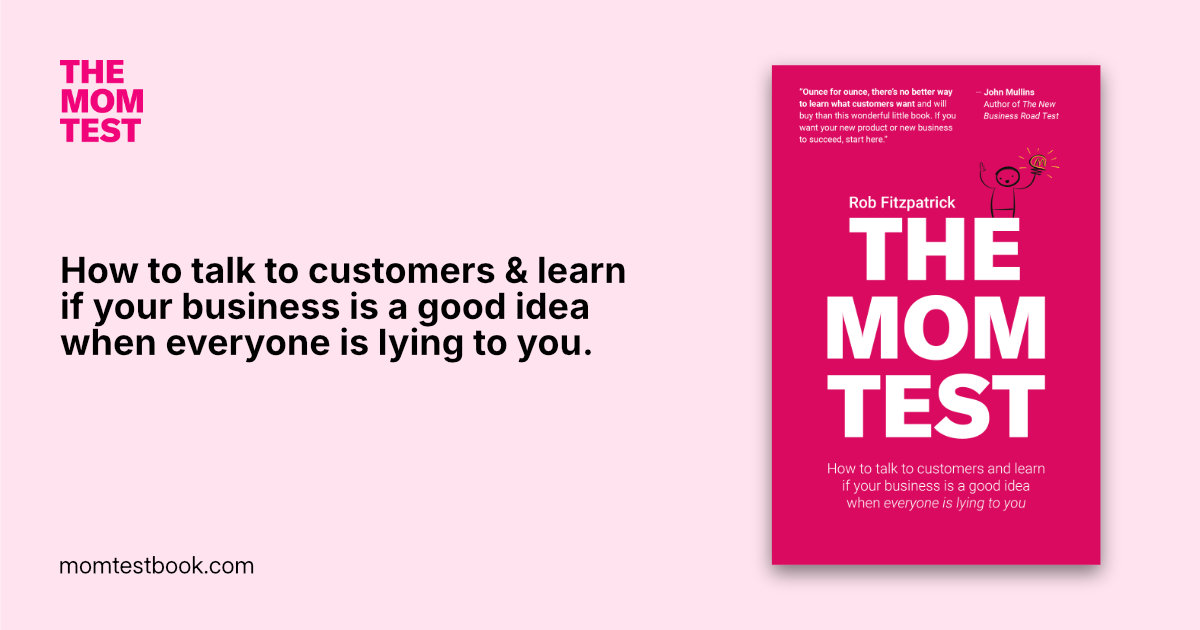
Next on the map: user research, then usability testing.
Related
The Mom Test
Talk about their life, not your idea. Ask about the past, not the future. Compliments are false positives; past behavior and money already spent are not.
User research
Interviews that avoid false positives, usability tests with five users, and synthesizing findings. Start here for the map.
Usability testing
Give realistic tasks, ask people to think aloud and do not help until they are stuck. About five users find most issues in a given design; then fix and retest.