Product thinking and discovery
Opportunity solution trees
A living map from outcome to opportunities to solutions to tests — so you compare ideas under the same customer need.
A flat idea backlog invites the loudest feature to win. An opportunity solution tree (OST) is a visual map from a desired outcome down through opportunities (customer needs), solutions and experiments. It replaces "whose pet idea is cooler" with structure.
Teresa Torres's framing is the practical operating system. The tree is a living artifact, not a one-time workshop poster.
Concept
An opportunity is an unmet need, pain or desire, written in customer language. Multiple opportunities compete; you choose where to play. Compare solutions under the same opportunity — that is the point of the tree.
The big idea
Outcome — a measurable result (activation rate, retention, revenue per user), not "ship feature X." See product metrics.
Solutions — at least two or three per opportunity so you do not marry the first idea.
Experiments — the cheapest next step that reduces risk. Not every solution deserves a build.
The tree makes strategy discussable: "We're focusing on opportunity 2 this month because interviews show higher intensity than opportunity 3." Update it as you learn.
Trade-off
A messy tree with real interview quotes beats a beautiful tree built in a room without customers. Spend about 70% of early discovery time on opportunities (research) and 30% on solutions and tests; invert only when the opportunity space is already well understood.
Walking through a choice
Outcome: raise week-1 invoice send rate from 40% to 55% among new freelancers. Three opportunity candidates: unsure what to charge; awkward to request payment details; onboarding feels like paperwork. Interviews last month showed strong emotion on payment details, so that branch is the focus. Solutions under it (magic-link form, Stripe-only, copy-link templates) now compete fairly. AI pricing sits under a different opportunity and does not hijack this week's debate.
Common mistakes
- Solution-first trees. Opportunities reverse-engineered from a roadmap that already existed.
- One solution per opportunity. You will marry the first idea.
- A poster that never updates. If last month's quotes are gone, it is decoration.
Check yourself
Two PMs argue templates vs AI pricing. What does the tree force them to do first?
Name the opportunity each serves. If they serve different needs, stop comparing them as rivals.
Should you spend most early discovery time drawing solutions?
No. Roughly 70% on opportunities (research) until the space is understood.
Key takeaways
- Map outcome → opportunities → solutions → experiments.
- Compare solutions under the same opportunity.
- Keep the tree messy and current. Quotes beat polish.
Further learning
Opportunity Solution Trees (Teresa Torres)Opportunity solution trees help product teams chart the best path to their desired outcome. They keep the team aligned as they manage the messy cycles of continuous discovery. In this article, we’ll cover what an oppo…Product Talk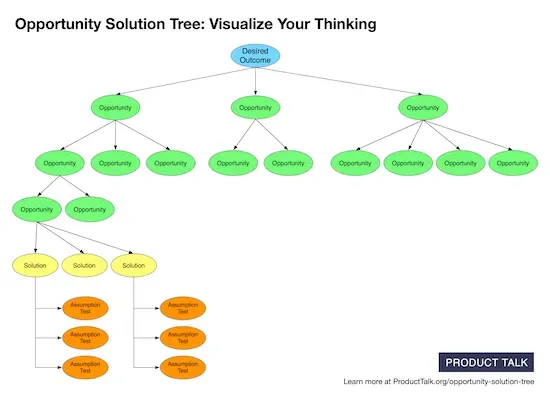
Next, list what must be true in riskiest assumptions.
Related
Continuous discovery and assumption testing
Weekly customer contact, opportunity solution trees and cheap tests before building.
Riskiest assumptions
State what must be true for an idea to work, then test high-hurt and high-uncertainty beliefs first.
Product metrics and the north star
Choosing a north star that reflects customer value, decomposing it into input metrics teams own, and pairing it with guardrails. Start here for the map.