Growth and monetization
Retention and engagement
Retention curves, cohort analysis, DAU/MAU and why retention is the foundation of growth. Start here for the map.
Acquisition without retention is a leaky bucket. You can spend forever pouring users in the top; if they leave, revenue, referrals and compounding growth loops never form. Retention is the percentage of a cohort that still uses the product after a given period — and it is usually the clearest signal of whether you have product-market fit.
For engineers, this is why reliability on the critical path, notifications that do not spam and features that deepen a habit all count as product work. Match the window to natural frequency: daily tools use D1/D7/D30; weekly tools use W1/W4/W12; monthly tools use M1/M3/M6. Using D30 for a monthly product makes healthy customers look churned.
When a growth proposal is "send more push," ask for the opt-out and long-term retention impact. When a product proposal is "add another tab," ask whether it deepens the core habit or dilutes it. Retention work is often subtraction and reliability, not net-new surface area.
Concepts in this section
Read them in order. Each one builds on the one before.
| Step | Concept | What it answers |
|---|---|---|
| 1 | The leaky bucket | Why does fixing churn beat buying more traffic? |
| 2 | Retention curves | What shape is PMF, and how do I compare cohorts? |
| 3 | Engagement metrics | How deep is use, and does DAU/MAU even apply here? |
| 4 | Retention levers | Habit, notifications, resurrection, quality, or dunning — which first? |
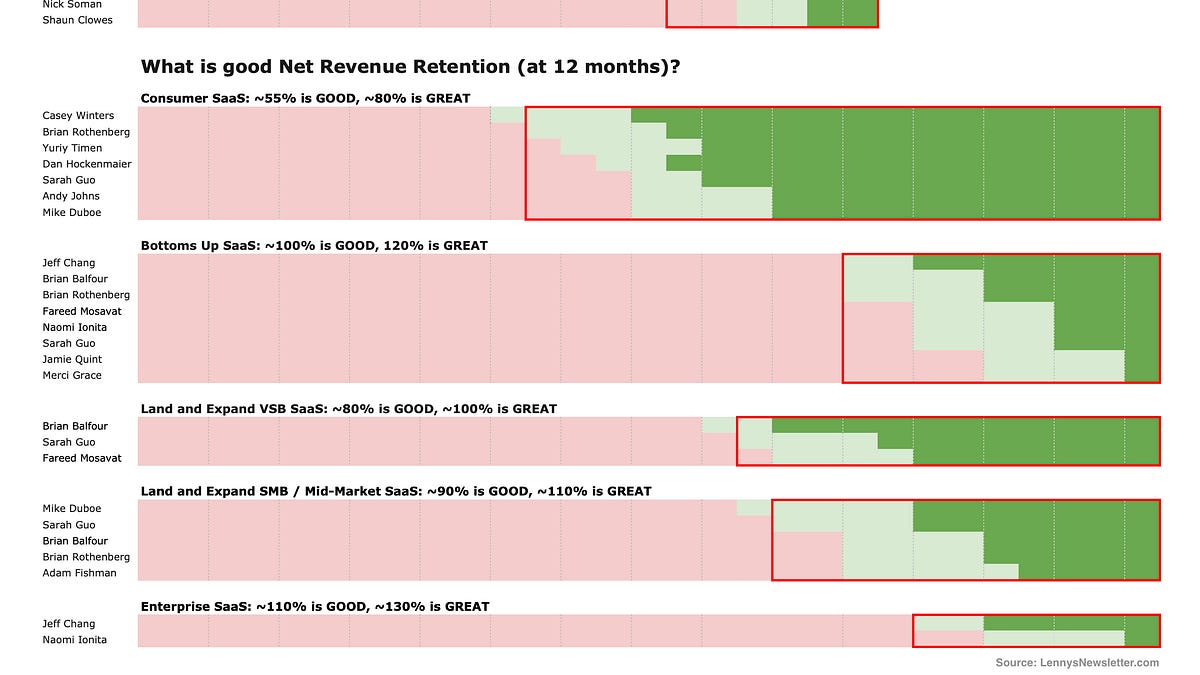
When a cohort looks bad, diagnose before adding features: wrong users (organic flattens, paid decays), never activated, activated but no habit, quality on the critical path or mix/seasonality. For paid products, split voluntary cancel, involuntary (failed cards — dunning is often the cheapest save) and contraction, which shows up in NRR.
SDE2-shaped habits: know your team's retention definition and where the curve flattens; instrument events needed for cohort queries before launch; when scoping, name which part of the curve the work moves. In interviews, draw a retention curve, mark the flat line and propose levers tied to user frequency.
Common mistakes
- Scaling acquisition on a curve that decays to zero. Paid channels then accelerate cash burn.
- Blended actives as retention. Mix of new, old, organic and paid hides the story.
- Copied DAU/MAU targets. A weekly B2B tool at 20% can be healthy; a messenger at 20% is on fire.
- Engagement features before diagnosis. Wrong users, never activated and broken sync each need a different lever.
Key takeaways
- Retention compounds; acquisition without it only scales the leak.
- Flatten above zero for PMF; decay to zero for a miss; smile for resurrection or network effects.
- Match metrics to natural frequency; breadth of return before depth of power users.
- Diagnose the curve, then pick habit design, careful notifications, resurrection, quality or dunning.
Further learning
Lenny Rachitsky's talk on growing startups covers retention benchmarks, activation and common pitfalls.
 16 Startup Metrics (a16z)We have the privilege of meeting with thousands of entrepreneurs every year, and in the course of those discussions are presented with all kinds of numbers, measures, and metrics that illustrate the promise and health…Andreessen Horowitz
Related
Activation and onboarding
Aha moments, time-to-value and onboarding flows that turn signups into active users.
SaaS metrics: ARR, churn and net retention
ARR and the bridge, bookings vs revenue, logo vs revenue churn, GRR, NRR, and the quick ratio.
Product-market fit
What fit feels like, how to measure it, the false positives that fool teams, and what changes after you find it.