Product thinking and discovery
Continuous discovery and assumption testing
Weekly customer contact, opportunity solution trees and cheap tests before building.
Discovery that happens once a quarter in a research block decays. Customers change, the product changes, and the backlog fills with stale assumptions dressed as requirements. Continuous discovery is the habit of keeping the product trio in weekly contact with customers, structuring what you learn, and testing the riskiest assumptions with cheap experiments before you burn delivery capacity.
Teresa Torres's framing is the practical operating system: weekly touchpoints, opportunity solution trees and assumption tests. It builds on user research and feeds prioritization and MVPs.
The output is not a 40-page deck. It is updated opportunities, revised assumptions, and decisions to test, build or kill.
Concepts in this section
Read them in order.
| Step | Concept | What it answers |
|---|---|---|
| 1 | Opportunity solution trees | How do we compare ideas under the same need? |
| 2 | Riskiest assumptions | What must be true, and what do we test first? |
| 3 | Cheap discovery tests | Fake door, concierge, Wizard of Oz — which one? |
| 4 | A week of discovery | What does the cadence look like Monday to Friday? |
The weekly habit
Who: PM, designer, engineer, together when possible.
How often: at least one customer touchpoint a week (interview, usability test, shadowing, support pairing). Weekly beats a big-bang project every six months.
What you produce: tree updates and decisions, not slides.
Why the engineer must be there: "that integration is a quarter" shows up in the room. Why weekly: skills atrophy; one interview a month becomes zero under deadline pressure. Protect it like on-call. Shrink to 20 minutes under crunch; do not cancel for three months.
This week, if you do nothing else: pick one outcome the team already owns. Sketch a one-page tree with three opportunities from support themes. Under the top opportunity, list two solutions and the single riskiest assumption for each. Design one cheap test with a kill criterion and a date. Put a weekly customer slot on the trio calendar — even if the first week is just recruiting.
Common mistakes
- Solution-first trees reverse-engineered from a roadmap that already existed.
- Trio of one — only the PM talks to customers.
- No kill criteria — zombies and fake doors left in production.
- Infinite discovery — never shipping a thin slice after assumptions are clear enough.
- Testing only what's easy — spikes without desirability tests.
Key takeaways
- Continuous discovery is a weekly trio habit, not a quarterly research project.
- Trees map outcome → opportunities → solutions → experiments and keep comparisons fair.
- Test high-hurt × high-uncertainty assumptions first. Write kill criteria. Celebrate early kills.
- Evidence updates the tree and feeds MVP scoping. Research that does not change decisions was theater.
Further learning
Teresa Torres's original write-up of opportunity solution trees.
Opportunity Solution Trees (Teresa Torres)Opportunity solution trees help product teams chart the best path to their desired outcome. They keep the team aligned as they manage the messy cycles of continuous discovery. In this article, we’ll cover what an oppo…Product Talk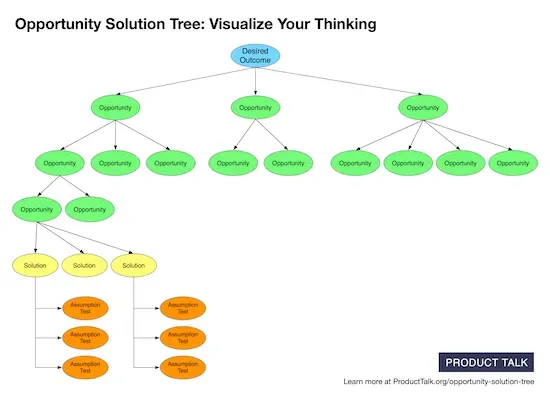 Product Talk (Teresa Torres)Learn a structured and sustainable approach to building great products from Teresa Torres and the rest of the Product Talk team.Product Talk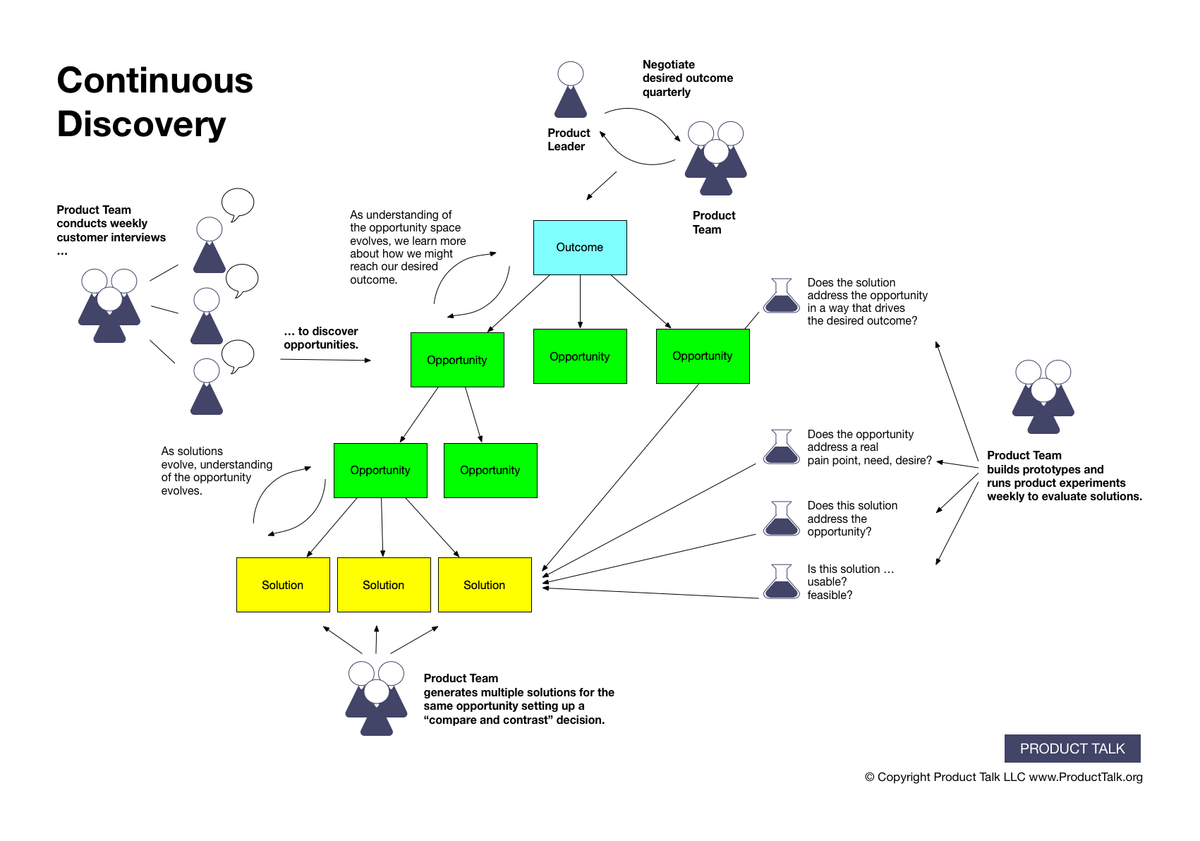
Teresa Torres at Lean Product Meetup on why weekly cadence beats project-based research.
Related
User research
Interviews that avoid false positives, usability tests with five users, and synthesizing findings. Start here for the map.
MVPs and scoping
Building the smallest thing that tests the riskiest assumption, and iterating.
Prioritization
RICE, ICE, Kano, cost of delay and opportunity cost: choosing what not to build.