Product thinking and discovery
Where problems come from
Mine support, sales, analytics, dogfooding and observation. Cross-check before a request becomes strategy.
You do not invent problems in a brainstorm alone. You mine them.
- Support tickets and chat logs — Cluster themes. Volume × severity beats one loud VIP. Tag "workaround mentioned" and "threatened to churn."
- Sales and customer success calls — Listen for deals lost, objections and "we built a spreadsheet instead." Ask to sit in; engineers hear technical constraints PMs paraphrase away.
- Analytics — Funnel drop-offs, high bounce on a step, repeated rage-clicks, search queries with zero results. Data shows where people struggle; interviews explain why.
- Your own pain — Using the product (or the competitor's) as a real user. Dogfooding finds intensity; it does not prove market size.
- Observation — Shadowing someone for an hour at their desk beats a survey. Watch the alt-tab dance between tools.
- Regulatory or market shifts — New laws, platform API changes, AI capability jumps create problems that did not exist last year. Trend matters.
Cross-check sources. A sales request for a logo park might be a checkbox RFP, not a daily pain. A support spike after a release might be a bug (feasibility), not a new opportunity. A founder anecdote needs replication across five other customers before it becomes strategy.
Concept
User research is how you test what you mined without lying to yourself. Mining tells you where to look. Interviews tell you why.
Walking through a loud request
Sales lost four deals to "automation" competitors. Support has 12 tickets/month about GL coding. Median clerk overtime is 6 hours at close. Three sources, same pain: manual coding at 50–200 person companies. That pattern is a candidate. A single VIP asking for a logo park on the invoice PDF is not — until you see it in other accounts.
Common mistakes
- One loud VIP becoming the roadmap.
- Treating a post-release support spike as a new opportunity when it is a bug.
- Founder anecdote as strategy with no replication.
Check yourself
Sales wants a logo park because one RFP listed it. Ship it? Not yet. Checkbox RFPs are not daily pain. Look for volume × severity and a workaround.
Dogfooding found a sharp edge. Does that prove market size? No. It proves intensity for you. Replicate across a segment you can reach.
Key takeaways
- Mine support, sales, analytics, dogfooding, observation and market shifts.
- Cross-check. Volume × severity beats one VIP; interviews explain funnel drop-offs.
- Dogfooding finds intensity, not market size. Replicate before it becomes strategy.
Further learning
The Mom Test (Rob Fitzpatrick)How to talk to customers & learn if your business is a good idea when everyone is lying to you.The Mom Test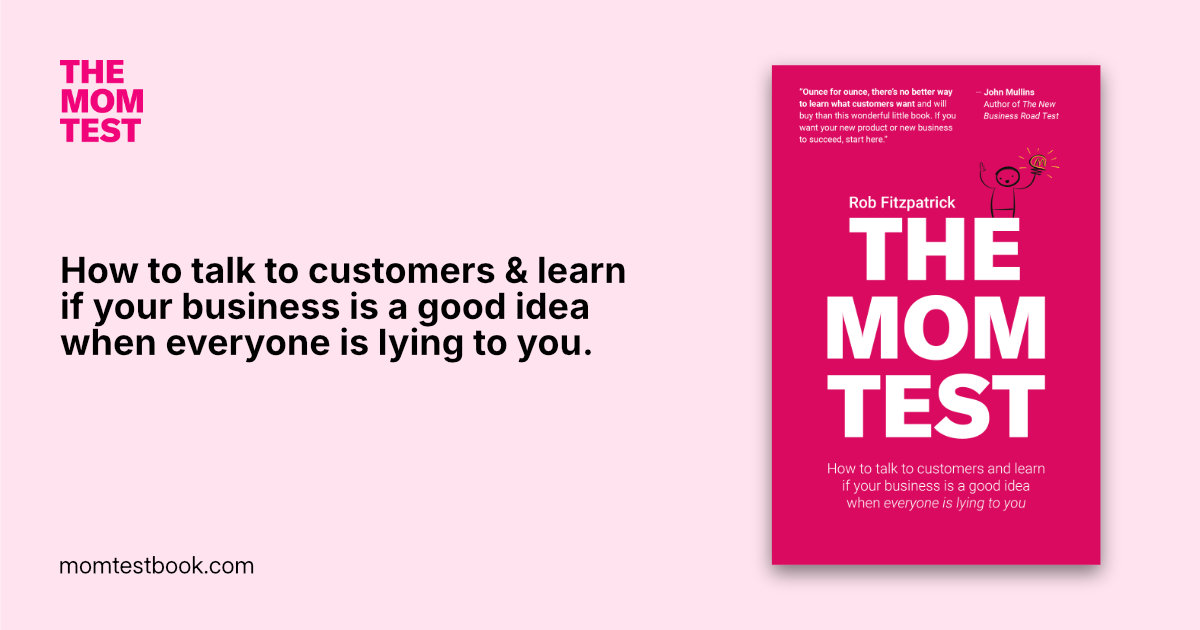
Next: problem statements with kill criteria.
Related
Finding problems worth solving
Pain intensity, frequency and willingness to pay — separating hair-on-fire problems from nice-to-haves.
User research
Interviews that avoid false positives, usability tests with five users, and synthesizing findings. Start here for the map.
Scoring problems
Intensity, frequency, workarounds and willingness to pay — the filter between hair-on-fire and nice-to-have.