Shipping and specialties
Product sense framework
Clarify, pick a north star, segment, name one pain, generate three distinct solutions, then choose an MVP with metrics. Interviewers reward decisions, not idea lists.
Product sense interviews test whether you can find a user, name a real pain, propose a solution that fits a company's goals and defend trade-offs under time pressure. Meta calls it product sense; Google often says product design; startups may just say "how would you improve X?" Interviewers are not looking for the "right" app idea. They are looking for whether they would trust you in a messy product discussion tomorrow.
Do not memorize a script. Internalize a sequence and waypoint — say what you will do next so the interviewer can redirect. "I'll segment next — stop me if you want a different cut" invites collaboration and saves you from a 15-minute wrong path.
Concept
Product sense in interview terms is structured empathy plus judgment: you can zoom into a specific user problem and zoom out to company strategy without getting lost, and you make a choice you can defend.
The big idea
| Type | Prompt shape | What they score |
|---|---|---|
| Design | "Design a product for volunteering" / "Design X for Y" | Structure, user empathy, creativity, prioritization |
| Improve | "How would you improve Instagram Stories?" | Diagnosis, taste, metrics, sequencing |
| Metrics / execution | "DAU dropped 10% — what do you do?" | Analytical rigor, causal thinking |
| Estimation | "How many elevators in San Francisco?" | Assumptions, decomposition (less common in pure PS) |
| Strategy lite | "Should Company Z enter market W?" | Clarity on users, competition, bets |
Most loops mix design + a metrics follow-up. End design answers in how you would measure success. If time runs out, skip a third idea before you skip the metric.
- Clarify (2–3 min). Geography, platform, company context, timeline, success definition. State assumptions when they stay vague: "I'll assume we're Meta, US-first, mobile-first, success is weekly active volunteers matching to opportunities."
- Goal and north star (2–3 min). Tie to mission, then pick a north star. "Confirmed volunteer hours per weekly active user — not app downloads."
- Users (5–8 min). List 3–4 meaningfully different segments. Score size, underserved-ness, fit to company strengths. Pick one. Weak: "Users who like volunteering." Strong: "25–40 urban professionals who already donate money but fail to convert intent-to-volunteer because discovery of nearby 2-hour shifts is broken."
- Pains (5–8 min). Walk discover → decide → attend → reflect. List 3, prioritize frequency × severity × ability to win. Pick one.
- Solutions (8–10 min). Three distinct approaches — not three flavors of a button. Dimensions: social graph vs marketplace vs content; AI assist vs human curation; supply vs demand. Choose one.
- MVP, metrics, trade-offs (5 min). V1 scope, explicit non-goals, input metrics, guardrails, biggest risk and how you'd learn in 4–6 weeks.
Interviewers reward decisions. Listing ten ideas without picking is a fail. Picking with a crisp "because" against your north star is the skill.
Walking through it
Interviewer: "Design a travel product for Meta." Weak answer invents a generic TripAdvisor clone. Strong answer picks group trip planning among existing friends (Messenger/WhatsApp graph), pain = coordinating dates and budgets in 40-message threads, solution = shared trip object with polls + payments split + destination shortlist, metric = trips with ≥3 contributing members per week, guardrail = spammy invites. You used Meta's unique asset and made a cut.
Common mistakes
- Boiling the ocean. "There are many users…" for 10 minutes. Pick a segment by minute 8.
- Feature salad. Ten incremental UI ideas, no strategy. Force three different solution shapes.
- No decision. "We could A/B all of them." Choose; offer what you'd test second.
Check yourself
- Time is almost gone and you have not named a metric. What do you cut?
A third brainstorm idea. Interviewers remember an empty ending more than a missing option.
- Why pick one segment instead of covering everyone?
Depth on one segment beats shallow coverage. Interviewers can always ask you to expand.
Key takeaways
- Run clarify → goal → segment → pain → solutions → MVP → metrics; waypoint as you go.
- Three distinct solutions, then a choice you can defend against the north star.
- End design answers in metrics and trade-offs.
Further learning
Lenny's definitive guide to product sense interviewsA step-by-step playbook to help you ace your PM interviewlennysnewsletter.com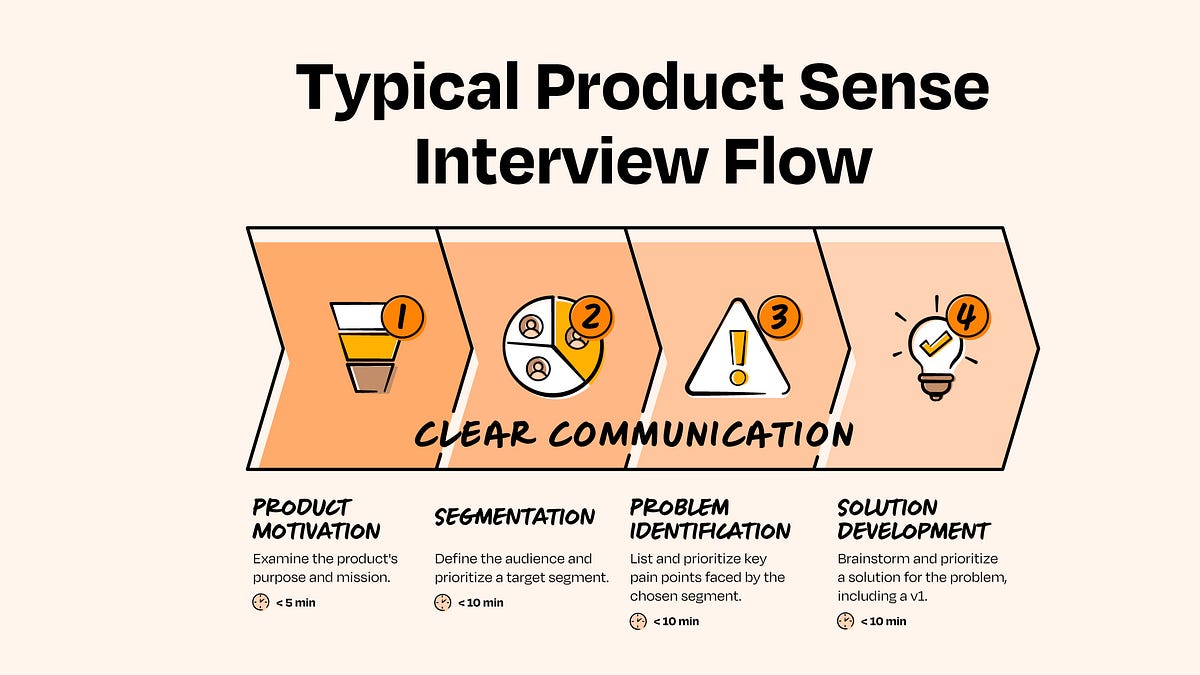
Next on the map: product sense interviews.
Related
Product sense interviews
Structured answers to product design, improvement and metrics questions. Start here for the map.
Product metrics and the north star
Choosing a north star that reflects customer value, decomposing it into input metrics teams own, and pairing it with guardrails. Start here for the map.
Jobs to be done
What customers hire a product to do — and how JTBD reframes competition and features.