Product thinking and discovery
The Mom Test
Talk about their life, not your idea. Ask about the past, not the future. Compliments are false positives; past behavior and money already spent are not.
Talking to users is easy to do badly. Bad research produces false positives: compliments, polite interest and "I'd buy that" that evaporate when money or habit is required. Good research produces evidence about their life — problems, workarounds, switching stories — that you can act on without fooling yourself.
Rob Fitzpatrick's Mom Test is a set of rules so even your mom cannot lie to you with encouragement. The spirit: people will say nice things about your idea; they will tell the truth about their life if you ask well.
Concept
A false positive in research is a signal that looks like demand (praise, survey interest, waitlist email) but does not predict behavior (usage, payment, retention). Compliments and hypotheticals are high-false-positive. Past behavior, budgets already spent and strong emotion about a real incident are lower-false-positive.
The big idea
Three rules:
- Talk about their life, not your idea. Pitching contaminates the data. Ask what they did last week when the problem showed up, not whether your mockup is cool.
- Ask about specifics in the past, not generics or the future. "Do you ever…?" and "Would you…?" invite fiction. "Tell me about the last time…" anchors reality.
- Listen more than you talk. If you are demoing for twenty minutes, you are not researching.
Bad questions: "Would you use an app that…?", "How much would you pay for…?", "Do you think this is a good idea?" Good questions: "How do you handle X today?", "What did you try last time this broke?", "What have you paid for related to this?", "Who else is involved when you decide?"
Signals to discount: "That's awesome," "I'd definitely use that," feature requests from people who never use what you already shipped. Strong signals: they show you their spreadsheet, introduce you to their boss, prepay or get animated describing a failure that cost them a client.
Support solves this user's ticket. Sales closes this deal. Research looks for patterns that should change the product. Mixing a hard pitch into a research call destroys Mom Test conditions. Prefer separate sessions, or split time: first 20 minutes their world, last 10 your ask.
This pairs with jobs to be done for what to listen for, and continuous discovery for making contact a weekly habit. Early startups use the same skills to hunt product-market fit.
Walking through it
You are exploring invoice chasing for freelancers. Weak interview: 15-minute pitch of your AI reminder product; they say "cool." Strong interview: they open their Sent folder and walk through three late invoices from last month; one client they stopped working with; they already pay $12/mo for a tool they hate because Stripe export is messy. You learn frequency, intensity, willingness to pay and a competitor — without showing a slide.
Common mistakes
- Pitching in the first five minutes. You will hear compliments, not life.
- "Would you pay $20?" Hypotheticals are not payment.
- Treating waitlist emails as demand. They are closer to a compliment than to a card on file.
Check yourself
- Rewrite "Would you use an app that reminds clients to pay?" as a Mom Test question.
"Tell me about the last time an invoice was late. What did you do first? What have you already paid for to solve this?"
- They say "That's awesome, I'd definitely buy it." What is that signal?
A false positive — a compliment. Ask what they did last month and what they already spend.
Key takeaways
- Their life, not your idea; past specifics, not futures; listen more than talk.
- False positives (compliments, hypotheticals) are the default failure mode.
- Strong signals: artifacts, introductions, money already spent, real emotion about a real incident.
Further learning
The Mom Test (Rob Fitzpatrick)How to talk to customers & learn if your business is a good idea when everyone is lying to you.The Mom Test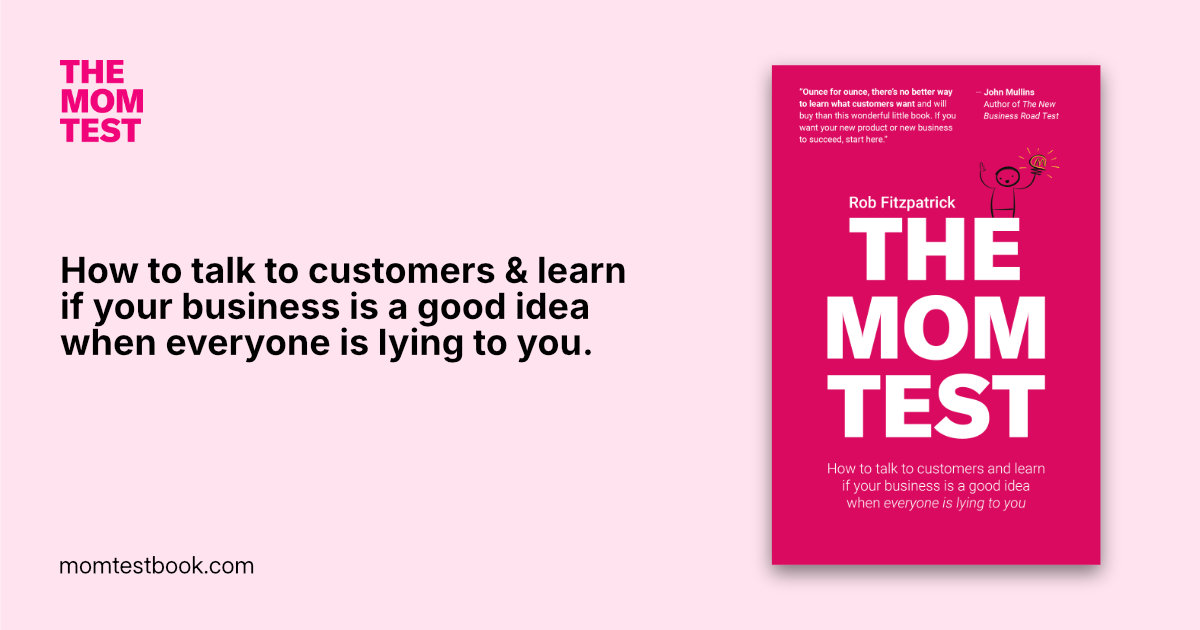
Rob Fitzpatrick live on how to talk to customers without pitching:
Next: how to run the conversation in user interviews.
Related
User research
Interviews that avoid false positives, usability tests with five users, and synthesizing findings. Start here for the map.
User interviews
Recruit the segment in your problem statement, run a 30-minute script that stays in their world and take notes in their words. Five to eight good interviews beat fifty mediocre surveys.
Jobs to be done
What customers hire a product to do — and how JTBD reframes competition and features.