Strategy and planning
PR/FAQ and working backwards
Write the press release as if the product shipped. If you cannot make a customer care, kill the idea cheaply.
Amazon's PR/FAQ flips the usual order: write the press release and FAQ as if the product already shipped, then work backwards into feasibility. Colin Bryar and Bill Carr document this in Working Backwards. The point is a customer-centric forcing function — if you cannot write an exciting customer-facing story, the idea is not ready.
Most PR/FAQs at Amazon never become products. That is the feature. Cheap killing of weak ideas saves eng years.
Press release (about one page)
- Headline a customer would care about
- Problem in plain language
- How the product solves it
- Quote from a hypothetical customer describing life after
- Getting started / availability
- No internal jargon, no feature laundry lists
Write it in the customer's vocabulary. If you catch yourself writing "leverages our ML pipeline to deliver actionable insights," you have failed the exercise — rewrite until a tired manager would forward it to a colleague.
FAQ (several pages)
This is where the hard questions live. External FAQ (price, who it's for, how it compares). Internal FAQ (unit economics, what has to be true operationally, hardest technical risks, cannibalization of existing products, why now).
Include the questions you hope nobody asks: unit economics, what breaks at 10× scale, which existing product this cannibalizes, and what you will tell the first angry power user who loses a workflow.
Trade-off
PR/FAQ vs traditional PRD. Use PR/FAQ when the customer narrative and business case are the uncertain part (new product, new market, big bet). Use a PRD when the problem is already agreed and you need shared requirements for delivery. Using a full PR/FAQ for a two-week tweak is bureaucracy; using a ticket for a new product line is negligence.
Some teams run a lightweight "working backwards paragraph" even for medium features: five sentences on who is happier and why. If that paragraph is boring, the PRD may be solving an internal itch rather than a user problem.
Walking through a boring paragraph
Draft: "We will leverage our ML pipeline to deliver actionable insights for enterprise stakeholders." Nobody forwards that. Rewrite: "Finance leads see which invoices will age past 30 days this morning, not after Friday's export, so collection calls happen while the customer still picks up." If you cannot write the second sentence, you are not ready to staff a squad.
Common mistakes
- Jargon press releases. If a customer would not forward it, the exercise failed.
- PR/FAQ for a two-week tweak. Bureaucracy.
- A ticket for a new product line. Negligence. Narrative and business case are the risk.
Check yourself
New market, new product line. Start with a PRD or a PR/FAQ? PR/FAQ. The uncertain part is whether a customer would care, not the P0 field list.
The working-backwards paragraph is boring. What does that mean? You may be solving an internal itch. Rewrite until a tired manager would forward it.
Key takeaways
- Write the customer press release first. If the story is weak, kill the idea before you staff it.
- The FAQ is where unit economics, cannibalization and 10× scale live.
- Use PR/FAQ for narrative risk; use a PRD for delivery alignment.
Further learning
Working Backwards — Bryar & CarrThe management processes behind Amazon’s success Build better mechanisms to invent, operate, and make decisions at scale. Colin Bryar and Bill Carr spent a combined 27 years as senior Amazon executives and wrote the b…Working Backwards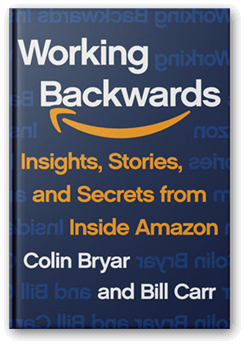 Working Backwards PR/FAQ processAmazon's customer-obsessed product development process, in which teams write the press release and FAQ before building anything.Working Backwards
PR/FAQ instructions and templateWorking Backwards PR/FAQ Instructions & Template Working Backwards PR/FAQ Instructions & Template Start with the customer and work backwards—harder than it sounds but a clear path to innovating and delighting customer…Working Backwards
Amazon Narratives: Memos and Working Backwards — Future / a16zLearn early inside stories behind (ultimately) big business moves like AWS, Kindle, Prime — and the leadership principles, decision making practices, and operational processes that got them there.Future
Working Backwards PR/FAQ processAmazon's customer-obsessed product development process, in which teams write the press release and FAQ before building anything.Working Backwards
PR/FAQ instructions and templateWorking Backwards PR/FAQ Instructions & Template Working Backwards PR/FAQ Instructions & Template Start with the customer and work backwards—harder than it sounds but a clear path to innovating and delighting customer…Working Backwards
Amazon Narratives: Memos and Working Backwards — Future / a16zLearn early inside stories behind (ultimately) big business moves like AWS, Kindle, Prime — and the leadership principles, decision making practices, and operational processes that got them there.Future
Next: acceptance criteria.
Related
PRDs, PR/FAQs and specs
Writing product requirement docs and Amazon-style PR/FAQs that align teams.
Writing a PRD
A short doc that answers problem, users, metrics, non-goals and P0 behavior — sized to the bet.
Requirements vs specs
Product owns observable behavior. Engineering owns how it is built. Mixing them too early locks the wrong decisions.