Markets and business models
Consumer business economics
Ads, subscriptions and virality: the economics of consumer apps.
Consumer businesses sell to individuals, not procurement committees. Distribution feels magical when it works and financially brutal when it does not. You get tiny payments (or ad impressions) multiplied by millions of users — or you get nothing.
The economic question is always the same: can you acquire and retain users cheaply enough that monetization covers the cost and leaves contribution margin? Most consumer apps fail that test. The ones that win usually combine strong organic acquisition with retention that compounds.
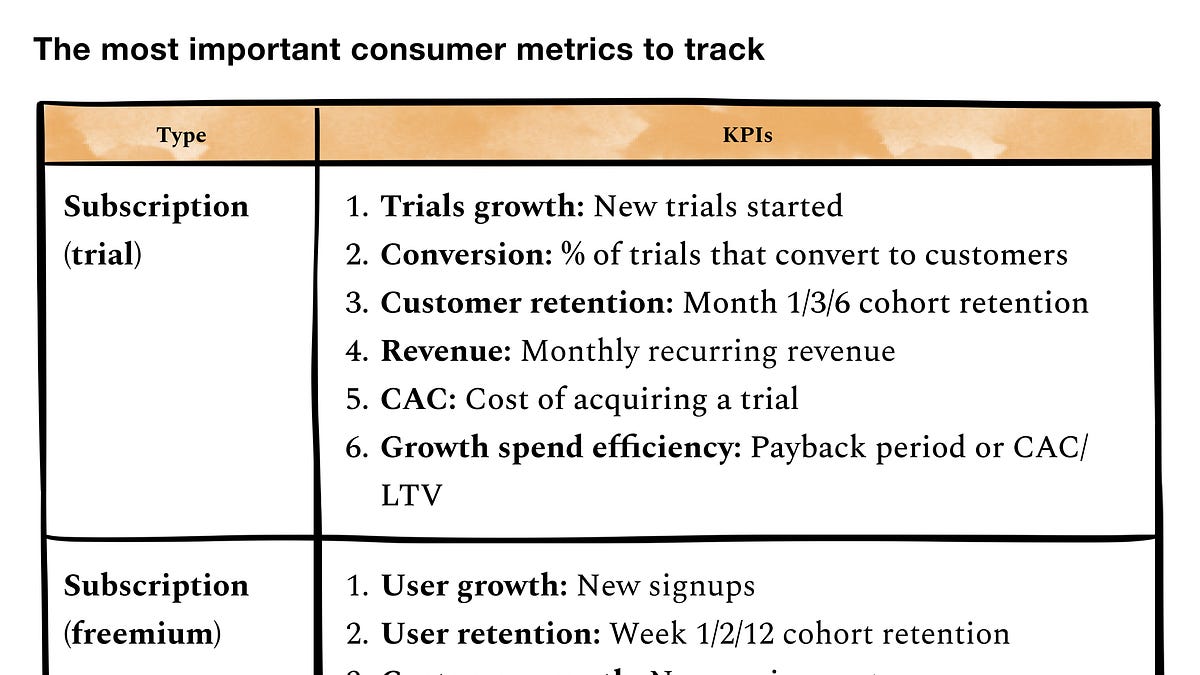
ARPU is revenue divided by users — say whether you mean payers or all actives. DAU/MAU is stickiness. Ads need huge habitual DAU. Subscriptions need conversion and retention at a tiny ACV after store fees.
A pair of sketches
Ads: 1M DAU, 20 impressions/DAU, $5 CPM → $100k/day ≈ $36.5M/year. At 100k DAU the same rates are ~$3.65M/year. Ads are a volume game.
Subscriptions: $10M ARR at $10/month needs ~83,000 payers. At 4% free→paid that is ~2.1M free actives. Paid CAC at this ARPU often does not pay back unless LTV is long and a large share of growth is organic.
Concepts in this section
| Step | Concept | What it answers |
|---|---|---|
| 1 | Consumer unit metrics | What are ARPU and DAU/MAU, and which denominator? |
| 2 | Ad-supported economics | How do impressions and CPM become revenue? |
| 3 | Consumer subscriptions | Why is freemium conversion and store tax the whole game? |
| 4 | Consumer virality | When is paid acquisition irrational? |
| 5 | Consumer retention | Which curve actually drives LTV? |
| 6 | Hits and platform risk | What happens when the store or the algorithm moves? |
As an engineer you will feel these economics in roadmap fights: growth teams pushing invites, monetization pushing paywalls, brand pushing "don't annoy users." The useful contribution is instrumentation — funnel metrics that match the model, cohort retention, and clear COGS if inference sits in the free tier. Pick one primary engine (ads or subscriptions) until the product works; add a hybrid when it funds the first, not when you are bored.
Common mistakes
- Planning ads at small DAU. The arithmetic needs huge habitual scale.
- Paid acquisition at consumer ARPU without long LTV or organic share.
- Watching install spikes while payer cohorts melt.
- One store, one algorithm, one ad network. Platform risk is existential.
Key takeaways
- Ad models need enormous scale: revenue ≈ DAU × impressions × CPM/1000.
- Consumer subscriptions live on conversion, churn and store fees. ACV is small.
- Freemium conversion is often low single digits. Most users never pay.
- Organic/viral acquisition is usually the only affordable growth; retention powers it.
- Measure cohort and payer retention. Plan for algorithm and fee shocks.
Further learning
16 Startup Metrics (a16z)We have the privilege of meeting with thousands of entrepreneurs every year, and in the course of those discussions are presented with all kinds of numbers, measures, and metrics that illustrate the promise and health…Andreessen Horowitz Lenny's Newsletter — consumer metricsWhich metrics matter most when building a B2C productlennysnewsletter.com
 Retention Is All You Need (a16z)AI companies donAndreessen Horowitz
 Why the best way to drive viral growth is to increase retention (Andrew Chen)Why the best way to drive viral growth to increase retention and engagement at andrewchenandrewchen.com
Related
Retention and engagement
Retention curves, cohort analysis, DAU/MAU and why retention is the foundation of growth. Start here for the map.
Growth loops and acquisition
Funnels vs loops, virality math, content and paid loops, and referral programs.
Business models
The main ways software companies make money, and the economics each implies for margin, sales motion and venture scale.