Markets and business models
Marketplace economics
Take rates, liquidity, chicken-and-egg dynamics and why some marketplaces become giants.
A marketplace connects two or more distinct groups and takes a cut of the value exchanged. Airbnb connects guests and hosts; Uber connects riders and drivers. The economic object is not "seats." It is liquidity: the probability that a participant finds a satisfactory match quickly. Without liquidity, take rates and fancy apps do not matter. With liquidity, network effects can make the business extremely hard to displace — the heart of many moats.
Never confuse GMV with SaaS ARR. A $1B GMV marketplace at a 10% take rate is a ~$100M revenue business.
Concepts in this section
Read them in order.
| Step | Concept | What it answers |
|---|---|---|
| 1 | GMV and take rate | What does the company actually keep? |
| 2 | Marketplace liquidity | How do you seed both sides without empty aisles? |
| 3 | Rake and disintermediation | When does the take invite bypass? |
| 4 | Managed vs pure marketplaces | Ops-heavy quality vs software margins? |
Take relative to value added is the whole game. A thin listing page at a 25% rake trains people to leave. Trust, payments, insurance and discovery can support a higher rake. Incentives muddy the picture: $60M of take minus $15M of promos on $500M GMV is a 9% effective take, not 12%.
Liquidity is local. 10,000 drivers nationwide and 3 in this city is not a network. Seed a narrow wedge — one city × one category — until fill rates and time-to-match are real, then expand. National GMV can rise while mature geos rot. Ask for same-store metrics. Ranking and matching models are revenue systems: a ranking change that improves booker conversion 3% can outweigh a quarter of feature work. See growth loops.
Not every market wants a marketplace. Bill Gurley's factors (fragmented supply, frequency or AOV, payment through the platform, network effects, ops you can bear) are a diligence checklist, not a scorecard. If you engineer a marketplace, your tests include fill rates, time-to-match, fraud/trust systems and payout correctness. When evaluating employers, ask for GMV vs net revenue, effective take after incentives, and whether liquidity is improving in the wedge geos — empty national maps with big GMV press releases are a smell.
Common mistakes
- Pitching GMV as ARR.
- Raising take to hit a revenue target without adding trust — then wondering about bypass.
- National launch with thin supply. Density is the asset, not map pins.
- Judging a city on gross take after driver bonuses, refunds and fraud.
Key takeaways
- Marketplace companies live on net revenue (
GMV × take), not GMV vanity. - Liquidity and chicken-and-egg seeding beat monetization early; narrow wedges win.
- Take rate has an optimum; too high invites bypass and competitors.
- Managed vs pure platforms trade margin for quality and cold-start speed. Automation is how managed players mature.
Further learning
A clear walkthrough of GMV vs net revenue, rake, and marketplace failure modes:
Series A investors on what they underwrite in marketplace deals:
 A Rake Too Far (Bill Gurley)In a casino, the term “rake” refers to the commission that the house earns for operating a poker game. With each hand, a small percentage of the pot is scraped off by the dealer, which in essence becomes the “revenue”…Above the Crowd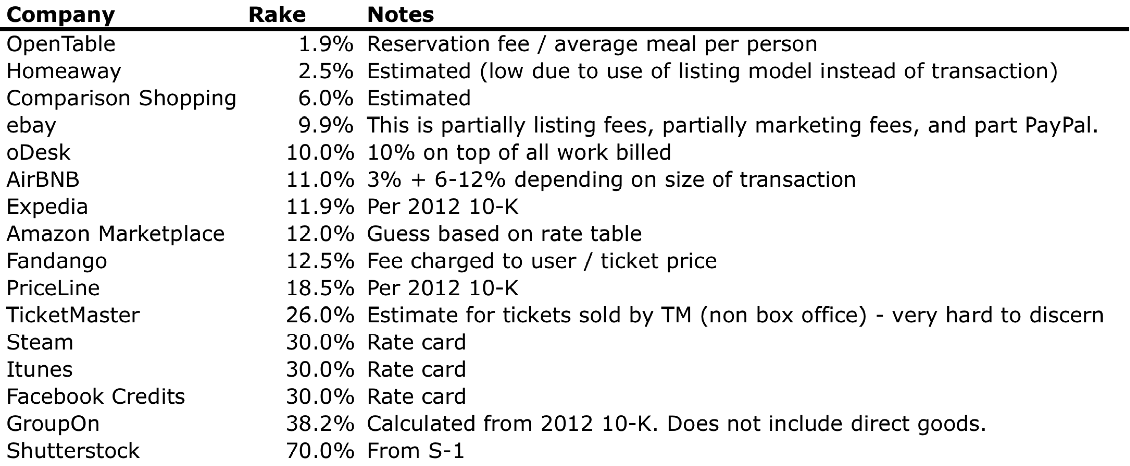
Related
Business models
The main ways software companies make money, and the economics each implies for margin, sales motion and venture scale.
Competition and moats
7 Powers, network effects, switching costs and aggregation theory, and what defends an AI company.
Growth loops and acquisition
Funnels vs loops, virality math, content and paid loops, and referral programs.