Building the company
Competition and moats
7 Powers, network effects, switching costs and aggregation theory, and what defends an AI company.
A company that grows fast but has no defense is a temporary cash machine: rivals copy the product, prices collapse, and growth becomes a race to the bottom. A moat is whatever makes it hard for a competent competitor to take your customers away at a similar cost. Investors care about moats because venture returns come from durable value capture, not from a single good year of revenue.
Features are not moats. Features can be copied. Scale, networks, switching costs, brands, exclusive resources and hard-to-copy processes can be. The engineering question is the same as the strategy question: what compounds in our favor as we get bigger?
Start narrow. Dominate a small market where you can be the default, then expand. Facebook began with Harvard students. Stripe started with developers who wanted payments in seven lines of code. You do not get network effects or switching costs on day one — you earn them.
Default to flanking an incumbent (a different customer, job, or channel) unless you have a 10× advantage on a dimension customers already pay for. Head-on feature parity plus a cheaper price usually loses.
Concepts in this section
| Step | Concept | What it answers |
|---|---|---|
| 1 | What a moat is | What protects returns, and why features do not? |
| 2 | 7 Powers | What are the durable advantages, with benefit and barrier? |
| 3 | Network effects | Which kind of network do we actually have? |
| 4 | Aggregation theory | Do we own demand, or supply someone who does? |
| 5 | Moats for AI companies | What defends an app when the model is a commodity? |
As an engineer, prefer work that deepens integration, data feedback loops, or multiplayer value over one-off features that demo well. When a PM asks for parity with a competitor, ask which Power you are building. When you evaluate an employer, "great team" and "hot market" are not moats. In interviews, "how would you compete with X?" wants a Power, a wedge segment and why the incumbent cannot respond without self-harm.
Common mistakes
- Calling features or funding a moat. Both can be matched.
- Claiming a network effect when a user gets full value alone.
- "Our moat is the model" on the same API everyone else calls.
- Out-featuring the incumbent on their terrain instead of flanking.
Key takeaways
- Moats protect long-term value. Features and funding do not.
- Helmer's 7 Powers give a shared language: scale, network, counter-positioning, switching costs, brand, cornered resource, process.
- Diagnose network type and liquidity before claiming one.
- Aggregators own demand. Suppliers need other Powers to keep margins.
- AI application moats sit in data, workflow, distribution and eval/trust — not in the base model alone.
Further learning
 Aggregation Theory (Stratechery)About | Articles | Updates | Speaking | Consulting What is Aggregation Theory? Aggregation Theory is a completely new way to understand business in the Internet age. Business schools suggest that w…Stratechery by Ben Thompson
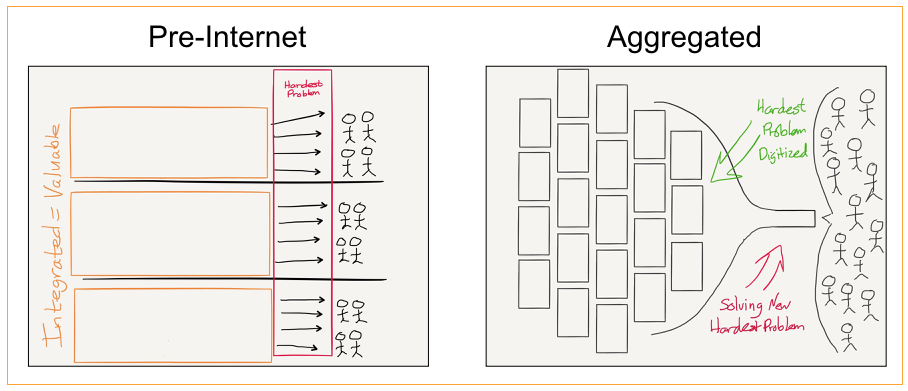 Zero to One — monopoly vs competition framing#1 NEW YORK TIMES BESTSELLER • “This book delivers completely new and refreshing ideas on how to create value in the world.”—Mark Zuckerberg, CEO of Meta “Peter Thiel...PenguinRandomhouse.com
Related
Product strategy and positioning
Vision, strategy, positioning and differentiation: deciding where to play and how to win. Start here for the map.
AI product strategy
What to build with AI, how to defend it, how to price it, and how evals become product requirements.
Marketplace economics
Take rates, liquidity, chicken-and-egg dynamics and why some marketplaces become giants.