Markets and business models
Rake and disintermediation
A take rate that exceeds the value of convenience, trust and demand invites bypass. Optimal rake funds liquidity without training people to leave.
Maximizing take rate can destroy the marketplace. If the rake exceeds the value of convenience, trust and demand generation, participants disintermediate — pay off-platform, move to a competitor, or build direct relationships. Bill Gurley's warning still holds: there is such a thing as a rake too far.
Concept
Disintermediation is the counterparties transacting without you after you introduced them. Infrequent, high-trust jobs (you met the contractor once; you text forever after) are the usual victims.
Walking through the equilibrium
Optimal take rate is high enough to fund liquidity, trust and product, and low enough that staying on-platform is rational for both sides.
Historical patterns:
- Platforms that push rake too high train power users to bypass.
- A lower rake with higher volume and loyalty often wins the long game (Booking.com's merchant-friendly posture vs earlier high-rake models is a common case study).
- App stores at ~30% invited regulatory and business backlash.
Trade-off
Higher rake vs denser liquidity. Raising take helps near-term revenue but can starve supply or push buyers away. In cold-start cities, many marketplaces subsidize (negative effective take) to buy liquidity, then normalize rake. Subsidies without a path to organic liquidity are just burned cash.
Cross-side elasticity: cutting take for supply might increase supply enough that demand conversion rises and total net revenue grows. Experiment carefully, geo by geo.
Disintermediation risk rises when:
- Transactions are infrequent and high-trust.
- The platform does not own payment or communication.
- Identity of counterparties is fully exposed early.
- Take rate feels like a tax on an already-formed relationship.
Mitigations: keep payments in-platform, add insurance/guarantees that off-platform lacks, progressive identity reveal, superior discovery for net-new matches, and ToS — knowing ToS alone rarely beats incentives.
Payments, identity, reviews, insurance and dispute resolution are why take rate is justified. Underinvest and bypass rises. Overinvest with heavy manual ops and you become a managed marketplace whether you intended to or not. Fraud rings and fake reviews are economic attacks on liquidity.
In the home-services sketch, if take rises from 18% to 25% without adding trust, bypass rises and the cohort math collapses even if GMV looks fine for a quarter.
Common mistakes
- Raising take to hit a revenue target without adding value.
- Exposing identity and taking payment off-platform on high-ticket, low-frequency jobs.
- Relying on ToS to stop bypass when the rake is the real incentive.
Check yourself
- Why might cutting take raise net revenue? More supply can improve fill rates and demand conversion enough to more than offset the lower rake.
- A contractor and a household text after the first job. What is the risk? Disintermediation — they no longer need you unless payment, insurance or discovery still pull them back.
Key takeaways
- Take rate has an optimum. Too high invites bypass.
- Subsidies can buy cold-start liquidity. Permanent subsidies cannot.
- Own payments, trust and new-match discovery, or the rake is a tax.
- ToS does not beat incentives.
Further learning
A Rake Too Far (Bill Gurley)In a casino, the term “rake” refers to the commission that the house earns for operating a poker game. With each hand, a small percentage of the pot is scraped off by the dealer, which in essence becomes the “revenue”…Above the Crowd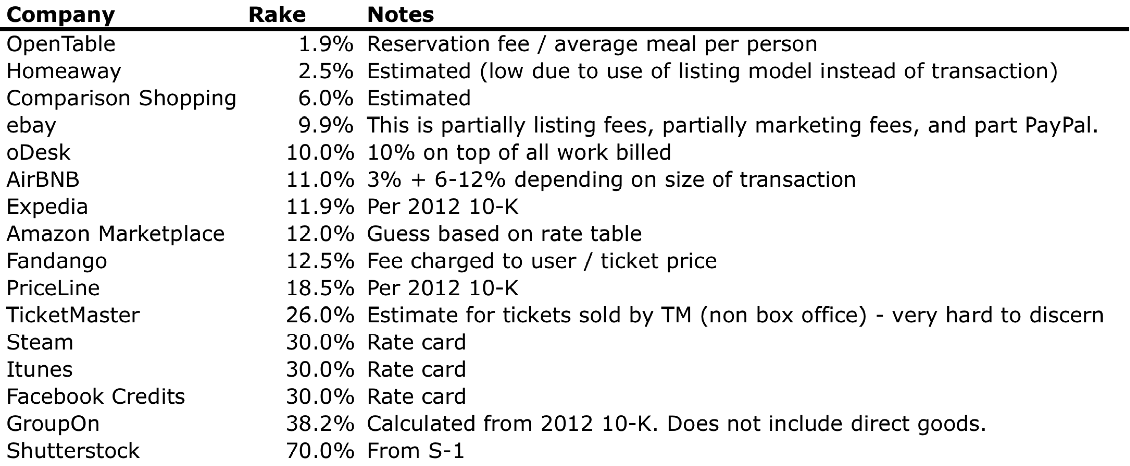
Next: managed vs pure marketplaces.
Related
Marketplace economics
Take rates, liquidity, chicken-and-egg dynamics and why some marketplaces become giants.
GMV and take rate
GMV is dollars transacted. Net revenue is GMV times the take. Never compare a GMV number to SaaS ARR.
Marketplace liquidity
Liquidity is the chance of a good match, fast. Buyers will not come without sellers. Density is local.