Building the company
Aggregation theory
Aggregators own demand and commoditize supply. Suppliers to someone else's aggregator negotiate from weakness.
Ben Thompson's aggregation theory (Stratechery) explains why some internet companies became enormous: when distribution is free and transaction costs collapse, aggregators sit between users and suppliers, own the consumer relationship and commoditize supply.
Google aggregates demand for information and sells attention; suppliers (websites) compete for ranking. Uber aggregates riders; drivers are modular supply. Netflix aggregates viewers; studios become suppliers competing for shelf space — until they vertically integrate.
Concept
An aggregator owns demand and makes supply modular. A supplier sells into someone else's aggregator (an app store, a cloud marketplace, an LLM distribution channel). Aggregators capture more value long-term. Suppliers can still build valuable businesses, especially with switching costs inside a niche, but they negotiate from weakness on price and placement.
Walking through the question
For a startup, the strategic question is: are you trying to be an aggregator (own demand, modularize supply) or a supplier to someone else's aggregator?
A vertical SaaS tool that owns the contractor relationship and plugs into many payment rails is closer to an aggregator of that job. A Chrome extension that lives or dies on the browser's store ranking is a supplier. An AI wrapper whose only acquisition channel is "we'll grow on Platform X's algorithm" should assume Platform X will tax you or clone you.
Build a direct relationship with the customer — email, brand, workflow embed — as early as you can afford. If your acquisition channel is a platform algorithm, treat that as rented land. See distribution and owned audiences.
Suppliers are not doomed. A niche with high switching costs (your system holds history, permissions and automations) can keep margins even on someone else's platform. You still need a Power besides "we are listed there."
Common mistakes
- Growing only on a platform's algorithm. Assume they will tax you or clone you.
- Confusing being listed with owning demand. The store owns the customer.
- Giving up on supplier businesses. Switching costs inside a niche can still defend margins.
Check yourself
Google Search: who is the aggregator, and who is supply?
Google aggregates demand for information. Websites are supply competing for ranking.
Why build email and workflow embed if you also list in a marketplace?
So you own a direct relationship. The marketplace can change ranking, fees or clone the feature.
Key takeaways
- Aggregators own demand and commoditize supply.
- Suppliers to aggregators need other Powers (switching costs, niche, brand) to keep margins.
- Do not rely on a platform algorithm as your only channel.
- Ask early: are we aggregating, or supplying someone who is?
Further learning
Aggregation Theory (Stratechery)About | Articles | Updates | Speaking | Consulting What is Aggregation Theory? Aggregation Theory is a completely new way to understand business in the Internet age. Business schools suggest that w…Stratechery by Ben Thompson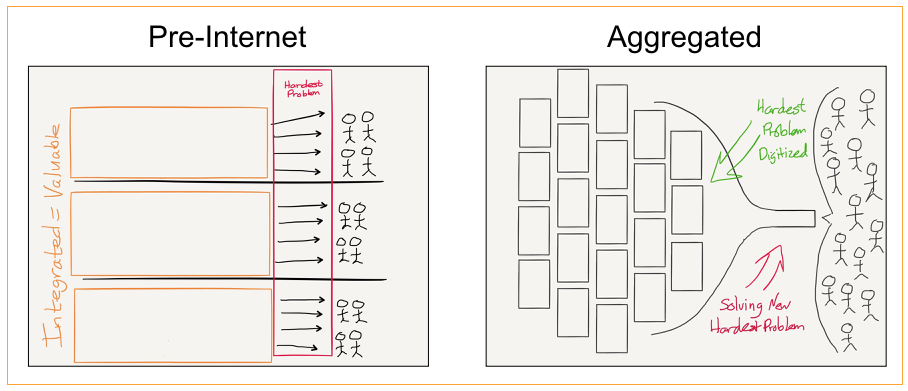
Next, moats for AI companies.