Owning projects
Design docs and RFCs
Writing design docs that get to a good decision quickly — structure, alternatives, review, and when a one-pager is enough.
A whiteboard conversation dies when someone erases the board. A Slack thread buries the decision under twenty replies. A design doc is the durable artifact: a short written proposal that forces you to name the problem, the options, and the trade-offs before you invent six months of code that solves the wrong thing.
Malte Ubl's description of how Google uses them is still the clearest: the point is not bureaucracy. Unstructured prose is often a better tool than code early in a project — cheaper to change, easier for experts outside your team to critique, and a record of why you chose A over B. Companies call these design docs, tech specs, RFCs, or ERDs; the name matters less than the habit.
If you are aiming for SDE2 and beyond, this is leverage. Owning a feature end to end means you can get alignment without waiting for someone else to "design it." A strong doc also lets a staff engineer review your approach in twenty minutes instead of pairing for an afternoon.
Concepts in this section
Read them in order. Each one builds on the one before.
| Step | Concept | What it answers |
|---|---|---|
| 1 | When to write a design doc | Skip, one-pager, RFC, or ADR? |
| 2 | Design doc template | Which sections do reviewers need? |
| 3 | Writing for reviewers | How do you lead with the decision? |
| 4 | Running a design review | Who comments, when do you meet, what gets recorded? |
The design names what and why. Estimation and planning names when and in what order. Written communication is the delivery vehicle for both.
A burst of review, worked out
Google-style design docs for major projects often land around 10–20 pages; incremental work uses mini docs of a few pages. Match the cost of writing and reviewing to the cost of getting it wrong.
A staff engineer can review a tight doc in about twenty minutes. That same design in an afternoon pairing session costs two people several hours. The doc is how your name attaches to a decision the org can still find next year.
Common mistakes
- Doc as theater. Written after the code ships "for process." Write before the expensive work.
- No non-goals. Scope expands until the project never ships.
- No alternatives. Reviewers smell advocacy and dig in harder.
- Unresolved comments. Shipping while threads are red means you did not actually decide.
- Orphan docs. Approved design with no link from the epic or ADR index.
Key takeaways
- Design docs catch wrong approaches while changes are still cheap and leave a record of why.
- Lead with the decision; support it with diagrams, numbers, goals/non-goals, and real alternatives.
- Right-size the artifact: ADR or one-pager for small reversible choices; fuller RFC for cross-team or multi-week work.
- Review async first; meet to resolve; record decisions so code review does not re-litigate them.
Further learning
Malte Ubl's overview of how Google uses design docs — still the best short cultural explanation.
Design Docs at Google (Malte Ubl)One of the key elements of Googleindustrialempathy.com Companies Using RFCs or Design Docs (Pragmatic Engineer)What companies follow an RFC-like process, and what are templates and examples to get inspiration from?The Pragmatic Engineer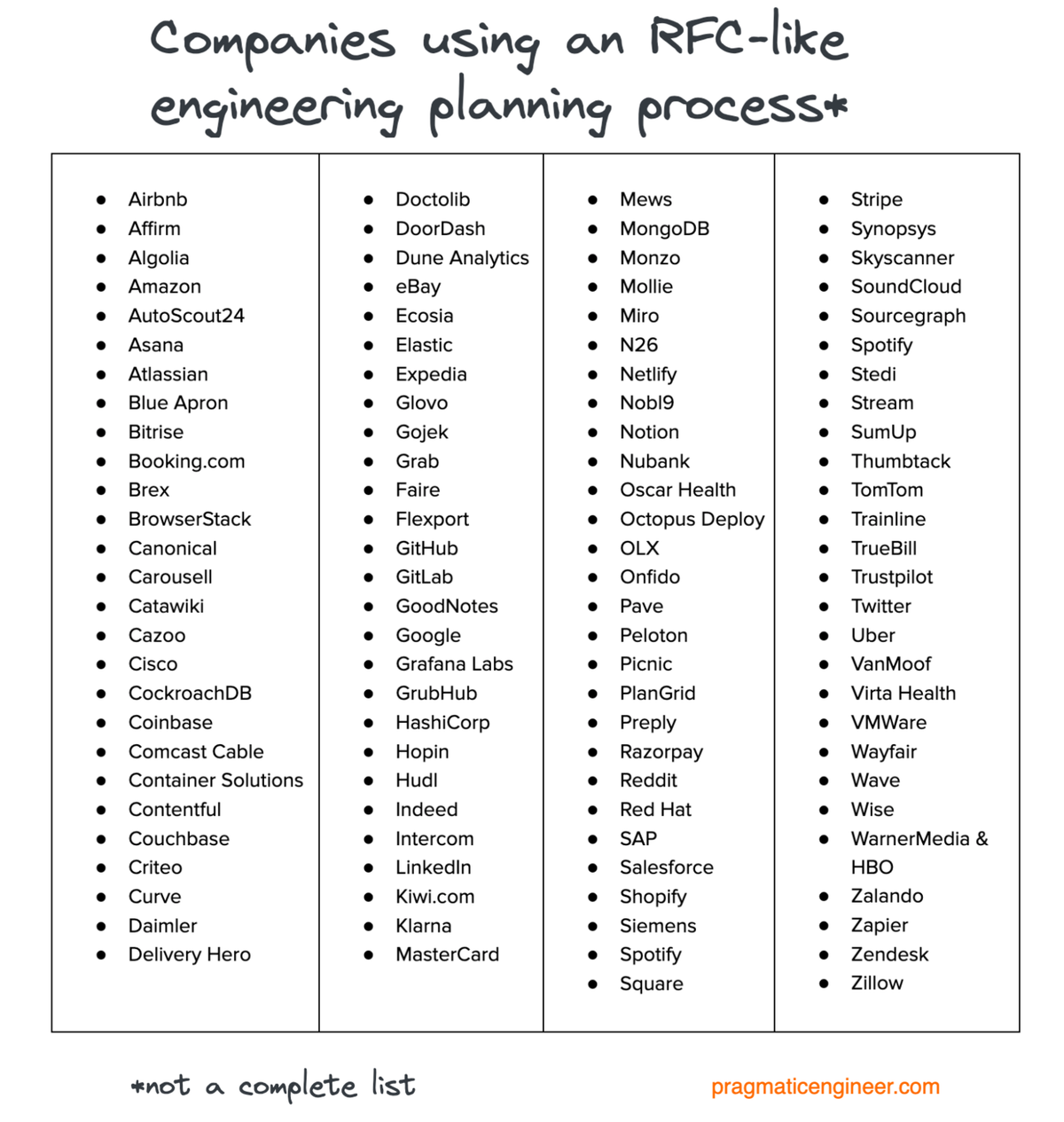
Related
The system design interview framework
A repeatable 45-minute structure, the signals interviewers score, and what changes between SDE2 and SDE3.
Written and verbal communication
Lead with the point, write for skimmers, and adjust depth for engineers, PMs and executives.
Estimation and planning
Breaking work into small tasks, estimating with ranges, de-risking early, and communicating slips before they become surprises.