GPU fundamentals
GPU architecture
SMs, warps, tensor cores and the memory hierarchy from registers to HBM, with H100/B200 numbers.
A CPU is built to finish one tricky instruction stream quickly. A GPU is built to finish millions of nearly identical arithmetic ops. Inference sits on that throughput machine. If you treat a GPU like a fast CPU, you will write kernels that look parallel and still crawl.
A modern server CPU might have tens of cores and hundreds of GB/s of DRAM bandwidth. A datacenter GPU has on the order of 100+ streaming multiprocessors, multiple TB/s of HBM, and tensor cores for matrix math. Clock rates are similar. The shape of parallelism is not.
Decode often looks small: one token, a batch of a few dozen sequences. The art is packing enough parallel work that the GPU's width is used.
Concepts in this section
Read them in order. Each one builds on the one before.
| Step | Concept | What it answers |
|---|---|---|
| 1 | Warps and SIMT | How does the chip actually run thousands of threads? |
| 2 | GPU memory hierarchy | Where do weights and the KV cache live, and how fast is that path? |
| 3 | Tensor cores and peak FLOPs | Which number on the datasheet should you believe? |
| 4 | GPU interconnects | When is tensor parallel viable, and when does the link become the model? |
Latency hiding in one picture
HBM latency is large compared to one arithmetic instruction. The SM keeps many warps resident and switches among them when one stalls. That is why occupancy and memory-level parallelism matter for bandwidth-bound kernels: without them the math units sit idle even though the chip is "waiting on memory."
Time to stream 80 GB on H100 ≈ 80e9 / 3.35e12 ≈ 24 ms
H100 BF16 ridge ≈ 989e12 / 3.35e12 ≈ 295 FLOP/byte
Those two lines are the hardware map for later pages. Single-stream decode lives near the 24 ms-per-weight-read floor. Prefill and large-batch work climb toward the ridge.
nvidia-smi reports HBM used vs free, GPU utilization, and sometimes power. Utilization near 100% does not mean you are compute-bound. A memory-bound decode loop can keep the chip busy copying. Power draw and tensor-core activity from Nsight are better hints.
HBM is the DRAM attached to the GPU. "GPU-Util" in many tools is an activity sampler, not FLOPs. A process can show high util while achieving a few percent of peak tensor TFLOPS.
Sharing and other chips
Multi-Instance GPU (MIG) partitions one physical GPU into isolated slices with dedicated memory. Useful for many small models. Painful for a 70B-class model that needs the full HBM pool. See GPU sharing.
Not every fleet is NVIDIA. The concepts transfer: compute vs bandwidth, on-chip vs off-chip memory, collectives. The APIs and peak tables do not. When you evaluate other accelerators, ask whether the model runs, what tokens/s you get at your SLO, and what the software tax is.
Common mistakes
- Explaining an OOM with leftover FLOPs. Memory is the scarce resource after weights load.
- Reading utilization as proof you are compute-bound. Copy-heavy decode looks busy too.
- Picking tensor-parallel size without reading NVLink topology.
- Using sparse datasheet peaks for a dense model.
Key takeaways
- GPUs buy throughput with massive multithreading and hide HBM latency by switching warps.
- Work is grids of blocks on SMs. Warps of 32 threads run in SIMT lockstep.
- HBM capacity and bandwidth bound model size, batch and decode speed. FLOPs bound prefill.
- Tensor cores dominate useful LLM math. Believe dense peaks.
- NVLink makes in-node tensor parallel viable. PCIe and multi-node links are much thinner.
Further learning
NVIDIA Hopper Architecture In-DepthEverything you want to know about the new H100 GPU.NVIDIA Technical Blog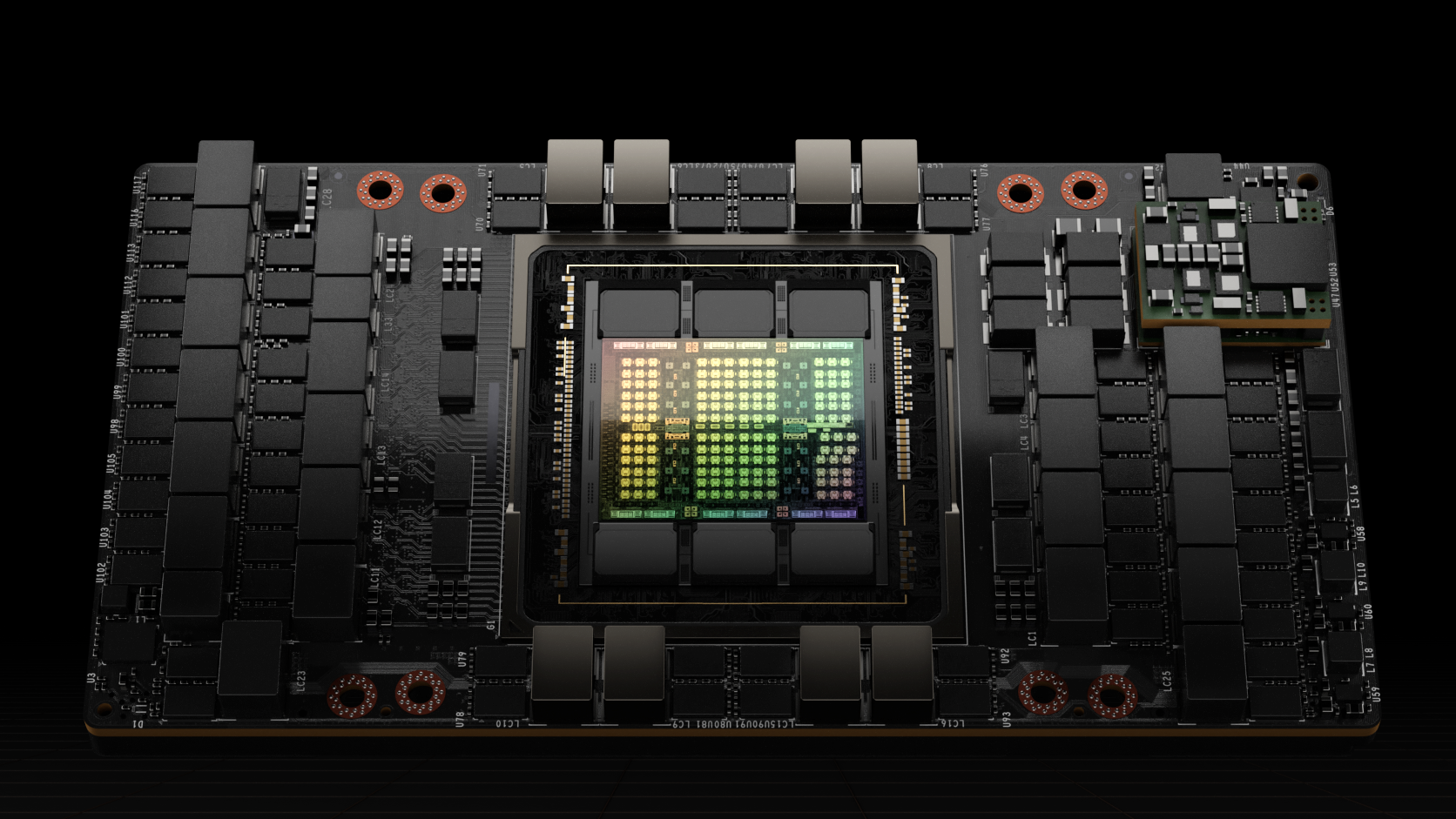 NVIDIA GPU Performance Background User's GuideGPUs accelerate machine learning operations by performing calculations in parallel. Many operations, especially those representable as matrix multipliers will see good acceleration right out of the box. Even better pe…NVIDIA Docs
How to Scale Your Model: GPUsWe love TPUs at Google, but GPUs are great too. This chapter takes a deep dive into the world of GPUs – how each chip works, how theyHow To Scale Your Model
NVIDIA GPU Performance Background User's GuideGPUs accelerate machine learning operations by performing calculations in parallel. Many operations, especially those representable as matrix multipliers will see good acceleration right out of the box. Even better pe…NVIDIA Docs
How to Scale Your Model: GPUsWe love TPUs at Google, but GPUs are great too. This chapter takes a deep dive into the world of GPUs – how each chip works, how theyHow To Scale Your Model
Peter Messmer's CUDA Part A is a spoken tour of the architecture and the programming model.
Related
Warps and SIMT
GPUs schedule work in warps of 32 threads that share one instruction. Divergence and occupancy decide how much of the chip you actually use.
GPU memory hierarchy
Registers, shared memory, L2 and HBM, with H100 numbers, and why inference runs out of memory more often than it runs out of FLOPs.
The roofline model and arithmetic intensity
Predicting performance from FLOPs and bytes: compute-bound vs memory-bound. Start here for the map, then work the examples.